Research
This page lists my published and accepted research work in reverse chronological order. I am deeply grateful to my supervisors for their guidance and to my collaborators for their support.

Design Friction for Writing with AI Chatbots: Probing the Tradeoff Between Engagement and Burden
Helen Weixu Chen and Katy Ilonka Gero
Abstract: AI chatbots can help people write faster, but they can also encourage overreliance by making it easy to turn minimal input into usable text. We study turn-level design friction: intentional constraints added to each chatbot exchange that slow, limit, or redirect how users request, access, or use model responses. We designed three friction probes for chat-based writing: input-scaled output, gated reveal, and sentence-limited output. In a within-subject study with 24 participants, these probes increased workload and task duration compared with a conventional AI chatbot baseline, while also increasing perceived ownership and recall of participants’ own writing. However, their effects were uneven. Interaction logs and interviews suggest that friction was most useful when added effort redirected users toward task-relevant decisions, such as decomposing the writing task, specifying intent, or assembling ideas themselves. It was less useful when users treated the constraint as a rule to satisfy, tried to restore a normal chatbot workflow, or shifted effort toward managing the interface. (To appear in UIST 2026) DOI Poster Demo
Make or Take: How Students Navigate Self-Created and Instructor-Provided Cheat Sheets
Helen Weixu Chen, Victoria Sakhnini, and Lesley Istead
Abstract: The use of cheat sheets in exams is often framed as a way to reduce cognitive load and support student performance. However, little is known about how students choose between self-created and instructor-provided cheat sheets, or how these choices relate to their broader approaches to exam preparation. We conducted a longitudinal study in a senior-level undergraduate software requirements course, where students could use either an instructor-provided or a self-created cheat sheet for both the midterm and final exams. Across three survey waves, we received 53, 50, and 44 responses, respectively. 41 students completed all three surveys and formed the longitudinal cohort used to examine how choices and experiences evolved over time, while exam-specific analyses used all available responses from the corresponding wave. Our findings identify several considerations that shaped students’ choices, including trust in instructor expertise, the desire for personalization, and preparation efficiency. We further show how students’ attitudes shifted over time and how their preferences were reflected in patterns of cheat sheet use, perceived content coverage, and challenges encountered during the exams. DOI
Sketch Bug: Using Sketch-Based Input for Interactive Code Debugging
Helen Weixu Chen and Daniel Vogel
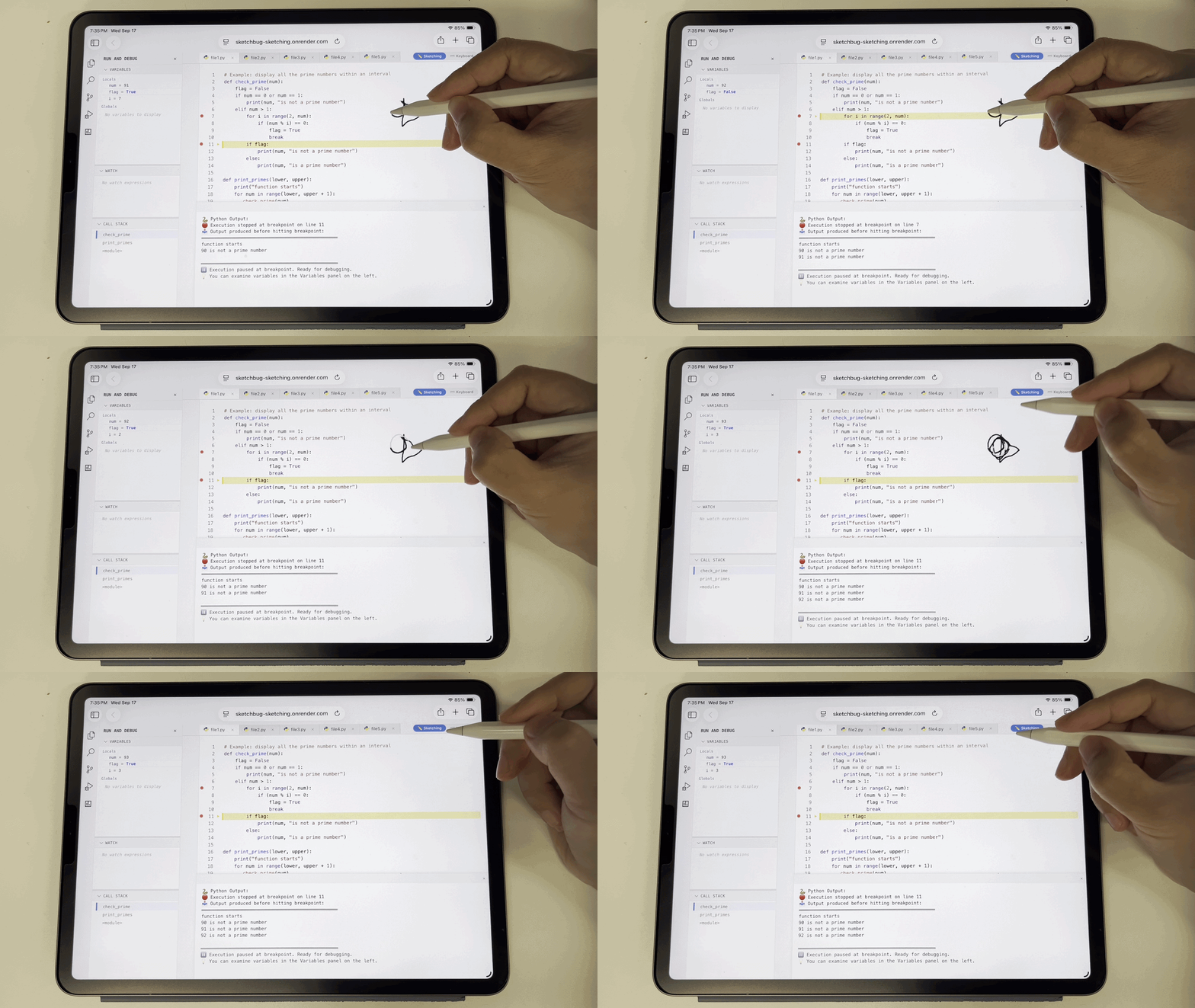
Abstract: We investigate sketch-like pen input as an alternative way to support execution control in interactive debugging. In our interface, programmers draw lightweight marks to set breakpoints, use symbolic strokes to control execution, and extend strokes into spirals to repeat traversal actions. The prototype combines gesture recognition with Python execution tracing in a conventional editor interface. In a controlled study with 24 programmers, we compared the sketch interface with conventional mouse-and-keyboard input on debugging tasks that required breakpoint placement, step-wise execution, and runtime state inspection. The results show that sketch-like input can support these execution-control tasks, while also introducing challenges in precision, recognition, and gesture recall. Our findings suggest that pen input is most promising where debugger interactions benefit from spatial grounding or continuous movement, rather than as a wholesale replacement for conventional debugging controls. (To appear in GI 2026) DOI

Thinking Inside the Box: Building User Interfaces with Question-Guided Inputs
Sejal Agarwal*, Helen Weixu Chen*, Daniel Vogel, and Anamaria Crisan
Abstract: Generative Artificial Intelligence (GenAI) tools are rapidly being used to support user interface (UI) development. When building UIs, AI chatbots are highly effective at instantiating and designing projects; however, the quality of the AI response is highly dependent on the user’s ability to translate their ideas into well-structured and defined prompts. Factors like varying AI literacy, can lead to vague inputs, inefficient iteration, and suboptimal outputs. Furthermore, there has been little innovation in how users engage with AI chatbots, as most chatbots rely on free-form inputs from the user. We investigate prompting format as an interaction design problem by comparing a free-form format (FFF) with a question-guided format (QGF) that helps users structure their initial requests before code generation. A within-subject study with 12 participants completing two comparable UI-building tasks found that the QGF enabled significantly fewer iterations and revisions, illustrating that answering guided questions helps create a more satisfactory initial prompt. Interview results also revealed that the QGF encouraged more deliberate reflection on requirements, but also introduced extra time and a sense of constraint for some participants. Our findings highlight a fundamental trade-off between speed and structured guidance, informing the design of future GenAI interfaces for development. (To appear in GI 2026) DOI

A Multi-Modal Exploration of Diversity in Visual Media Production Industries
Lesley Istead, Helen Weixu Chen, Albert Lay, and Chris Joslin
Abstract: because survey participation is often low and membership demographics are rarely public. We explore a multimodal approach to studying diversity in the Canadian screen industry by combining an anonymous survey with AI-assisted analysis of publicly available LinkedIn profiles. This study compares self-reported data from 167 survey participants with broader, but less certain, annotations from over 10K public profiles. Findings suggest gendered differences in role distribution and salary, regional salary variation, and reported discrimination related to gender and age. We discuss how public profile analysis can complement surveys while introducing platform bias and automated annotation uncertainty. DOI
The Therapeutic Potential of AI-Generated Art in Short-Term Stress Management
Pavaris Thongthanomkul, Helen Weixu Chen, and Lesley Istead
Abstract: Art therapy is a combination of the creative process and psychotherapy that helps individuals with imagery, colour, and shape to promote self-exploration and support mental well-being. This therapy is often hands-on, providing tactile as well as expressive feedback. However, new generative AI tools open up artistic creation to wider audiences through simple text-to-image generation. We present our experiment that compares the stress-reducing impact of generative AI to traditional methods. Ultimately, we find that text-to-image generative AI can reduce short-term stress through emotional expression and catharsis, but it is not as effective as traditional methods, owing to the lack of tactile feedback. DOI

Enhancing AI Explainability for Non-technical Users with LLM-Driven Narrative Gamification
Yuzhe You, Helen Weixu Chen, and Jian Zhao
Abstract: Artificial intelligence (AI) is tightly integrated into modern technology, yet existing exploratory XAI visualizations are primarily designed for users with technical expertise. This leaves everyday users, who now also rely on AI systems for work and tasks, with limited resources to explore or understand AI. In this work, we explored the use of LLM-driven narrative gamification to enhance the learning and engagement of exploratory XAI visualizations. Specifically, we designed a design probe that enables non-experts to collect insights from an embedding projection by conversing directly with visualization elements similar to game NPCs. We conducted a preliminary comparative study to assess the effectiveness and usability of our design probe. Our study shows that while the tool enhances non-technical users’ AI knowledge and is perceived as beneficial, the impact of gamification alone on understanding remains inconclusive. Participant opinions on engagement are mixed: some find it enriching, while others see it as disruptive. DOI

Self-Disclosure and Beyond: Takeaways from an Online and In-Person Computing Ethics Course
Helen Weixu Chen, Maura R. Grossman, and Daniel G. Brown
Abstract: We evaluate the amount and nature of self-disclosure in two versions of a 400-level computing ethics course focusing on discrimination and surveillance. The study involved 30 participants enrolled in two identical course offerings, taught by the same pair of instructors, but delivered in different formats: online versus in-person. Our analysis concentrated on the extent and contents of self-disclosure by both students and instructors. By using both quantitative and qualitative methods, we observed a higher prevalence of self-disclosure by both students and instructors in the online section. Notably, an analysis of demographic data revealed that minority group members were particularly active in self-disclosure in both formats. Overall, our findings suggest that an online setting may be more effective for delivering computing ethics courses where a primary goal is increasing open discussion and self-disclosure among participants. DOI Poster Demo

"Imagine a Dress": Exploring the case of task-specific prompt assistants for text-to-image AI tools
Helen Weixu Chen* and Lesley Istead*
Abstract: In this paper, we explore the impact of task-specific prompt assistants for text-to-image generative AI tools through a user study. Participants were asked to recreate a dress with SDXL using either a prompt assistant tailored to dress design, or no assistant at all. A detailed analysis of the results and feedback suggests that for this specific task, a tailored assistant improves result satisfaction and accuracy. This style of assistant helps users focus on the task by providing a detailed, visual, and organized approach to describing the object—enabling faster production times and more accurate descriptions with less ambiguity. DOI